
Michigan Death Index
Michigan death records date back to 1867, when the state first required registration of all deaths. The Michigan Death Index covers death certificates, historical ledger records, and vital records data maintained by the Michigan Department of Health and Human Services and by county clerks across all 83 counties. You can search older records through the free GENDIS database for deaths from 1867 to 1897, or browse Michiganology for certificate images from 1897 to about 1952. Newer records are available through MDHHS or directly from the county clerk. This guide covers where to search, how to request copies, and what to expect when you look up the Michigan Death Index.
Michigan Death Index Overview
Where Michigan Death Index Records Are Kept
The main keeper of state death records is the Michigan Department of Health and Human Services (MDHHS) Vital Records office. It sits at the Capitol View Building, 3rd Floor, 201 Townsend Street, Lansing, MI. The phone is (517) 335-8666, and you can reach staff by email at vrcustomerservice@michigan.gov. This office holds records from 1867 to the present. It is the central repository for Michigan death certificates filed statewide.
Each of Michigan's 83 county clerks also holds death records for deaths that occurred within that county. County-level copies are separate from the state copy. Both are certified and legally valid. For local records or older deaths tied to a specific place, the county clerk can often be faster and less expensive than going through the state office. County fees generally run from $10.00 to $25.00, compared to the state fee of $34.00.
Michigan death records are public. Under MCL 333.2885, any person may request a certified copy of a death record. No relationship to the deceased is required. No reason for the request is needed. Records that are 75 years or older are specifically open for genealogical research under this statute. This is a key difference from birth records, which carry strict access limits in Michigan.
The MDHHS also maintains a mailing address for written requests: Vital Records Request, P.O. Box 30721, Lansing, MI 48909. Hours for in-person visits are Monday through Friday, 8:00 AM to 5:00 PM.
The Michigan Department of Health and Human Services Vital Records page at michigan.gov/mdhhs serves as the state's central hub for ordering death certificates and accessing information about vital records.
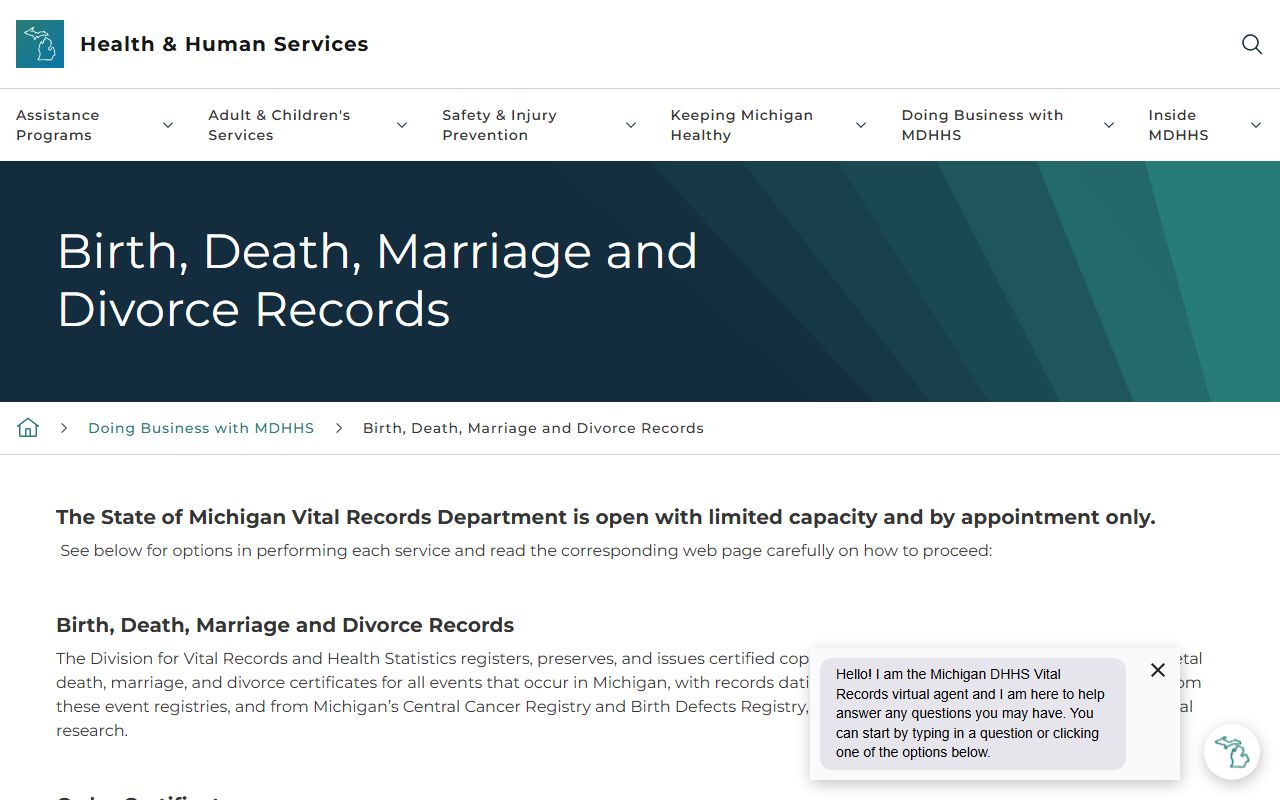
You can use this page to download forms, check fees, and find contact details for the MDHHS vital records office in Lansing.
How to Search the Michigan Death Index
Three free tools let you search Michigan death records before ordering a certified copy. Each tool covers a different time period, so the one you use depends on when the death occurred.
GENDIS, the Genealogical Death Indexing System, is run by the Division of Vital Records and Health Statistics. It covers deaths from 1867 to 1897 and holds more than 460,000 records. These records came from microfilmed death ledgers that Michigan genealogical societies transcribed over the years. The data includes the decedent's name, the father's last name, the year of death, and some basic demographic fields. You can use a wildcard (*) to search partial names. The database is free and requires no login. Search the GENDIS database at vitalstats.michigan.gov to start.
Michiganology, formerly called Seeking Michigan, gives free access to actual death certificate images from 1897 to around 1943. The index runs through 1952. No account is needed. Records are organized by county and last name. Coverage varies by year and county, and the project is still ongoing. Visit michiganology.org to search.
For deaths after 1952, check with the county clerk or MDHHS directly. Several counties also have their own searchable online indexes. Macomb County has a searchable death records index going back to 1867. Oakland County has a genealogy research database with records from 1900 to the present. Grand Traverse County posts an online death record index on the county website.
The GENDIS database at vitalstats.michigan.gov provides free public access to Michigan death records from 1867 to 1897, with over 460,000 indexed entries available for search.
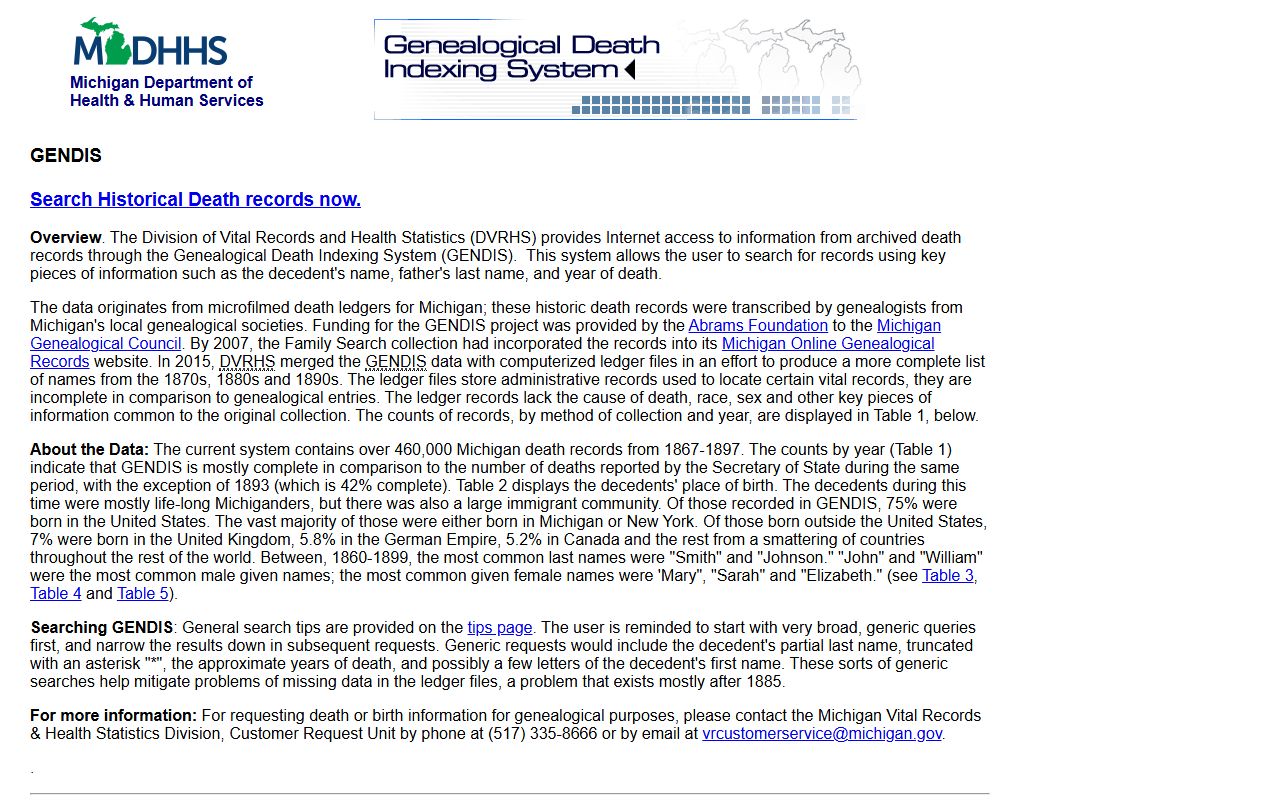
Use the wildcard search in GENDIS to find names with uncertain spellings or to search across a range of years in the early Michigan Death Index.
How to Request Michigan Death Records
Three methods are available for obtaining certified copies of Michigan death records: online through VitalChek, by mail, or in person at the MDHHS office in Lansing.
Online is the fastest route. VitalChek is Michigan's only authorized online service provider for state death records. You can order at VitalChek.com or start your request from the MDHHS online ordering page. Processing runs one to two business days for UPS delivery or about two weeks by regular mail. The state fee of $34.00 applies, plus a $12.50 VitalChek handling fee. You can add a $12.00 rush fee for faster service. Shipping costs are on top of all these fees. VitalChek also takes phone orders at 866-443-9897.
By mail, download and print the application form from the MDHHS website. Include a photocopy of your valid government-issued photo ID and send payment by money order or check payable to the State of Michigan. Mail everything to Vital Records Request, P.O. Box 30721, Lansing, MI 48909. Expect two to four weeks for processing.
In person, go to the Capitol View Building, 3rd Floor, 201 Townsend Street, Lansing. Same-day service is available for most records if you arrive before 3:00 PM. There is a $10.00 rush fee for same-day processing. Hours are Monday through Friday, 8:00 AM to 5:00 PM.
The MDHHS online ordering page connects you to VitalChek for same-day or next-day ordering of certified death certificates from the Michigan Death Index.
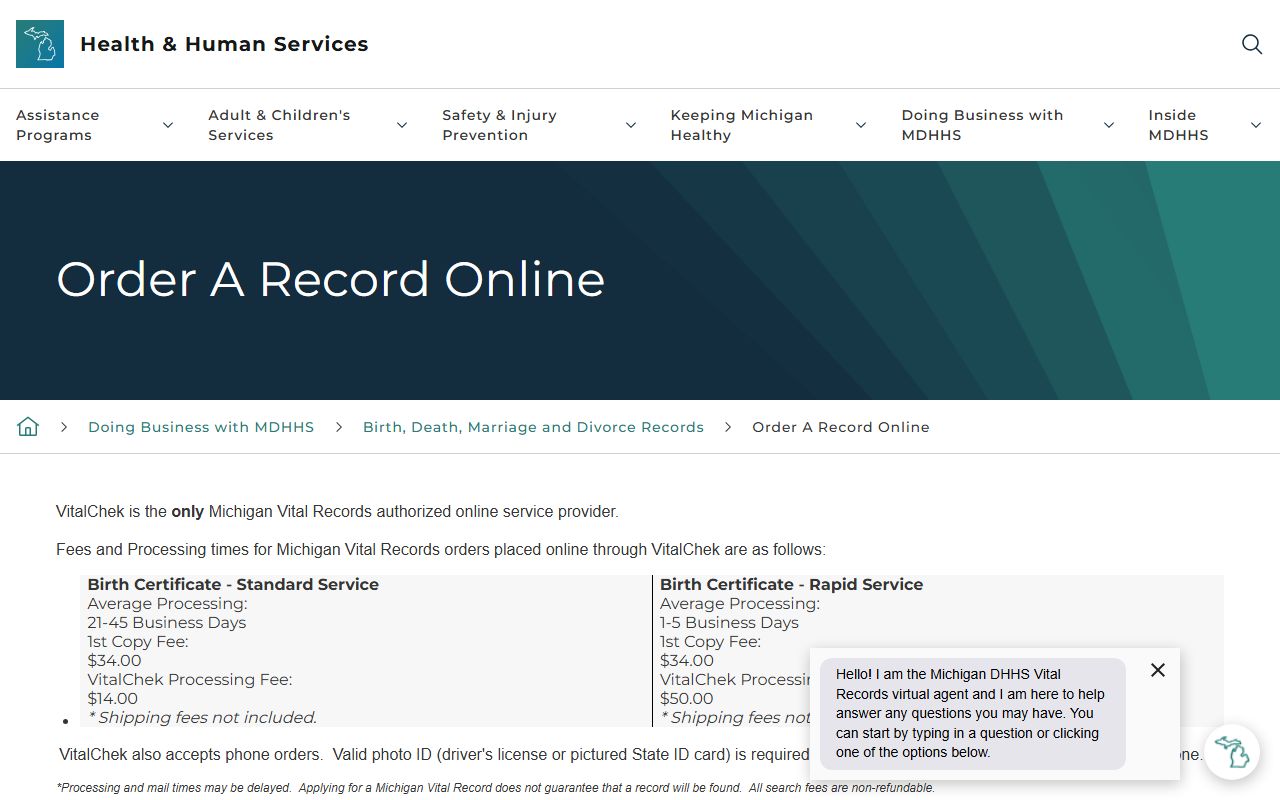
Orders placed through this portal can be delivered in one to two business days via UPS, making it the quickest way to get certified copies of Michigan death records.
Note: The $34.00 state search fee is non-refundable even if no record is found, so confirm the name and approximate date of death before ordering.
What Michigan Death Certificates Include
Michigan death certificates filed after 1897 contain a standard set of fields. The record shows the date and place of death, the full name of the deceased, sex, race, and marital status. Age appears in years, months, and days. Cause of death, place of burial, and the funeral director's name and address are all listed. Both parents' full names and birthplaces appear on most certificates from 1898 forward. The person's own birthplace, occupation, and birthplace of parents are also included.
Earlier records from 1867 to 1897 have fewer fields. The GENDIS database covers this period, but cause of death is missing from most records after 1885. Race and sex are absent from some early administrative entries as well. Pre-1897 deaths may have less complete information overall. Some deaths in remote areas of Michigan were never filed with the state, even after the 1867 law took effect.
Modern certificates filed through the Michigan Electronic Death Registration System (EDRS) are the most complete and accurate. Physician-certified cause of death, ICD codes, and other data fields are required. The EDRS has been in use since 2010 and is now active in 82 of Michigan's 83 counties.
Michiganology at michiganology.org offers free access to digitized Michigan death certificate images from 1897 to about 1943, a key span for genealogy research and family history work.
Records on Michiganology are organized by county and last name, and you can download certificate images without creating an account or paying any fee.
Michigan Death Index Laws and Public Access
Michigan death records fall under Part 28 of the Public Health Code, beginning at MCL 333.2801. These statutes govern registration, access, and penalties for vital records statewide.
MCL 333.2843 sets the filing rules. A funeral director who first takes custody of a body must obtain personal data from next of kin, get medical certification from the attending physician, and file the completed death certificate within 72 hours. This tight deadline helps ensure that the Michigan Death Index stays current and complete.
The key access statute is MCL 333.2885. It states that death records are public records in Michigan. Anyone may obtain a certified copy of any death record. You do not need to prove a family relationship. Records 75 years or older are open for genealogical research. Michigan's death records are among the most accessible in the country for this reason.
MCL 333.2894 and MCL 333.2896 cover penalties. Making a false statement in a death certificate, altering a certificate, or willfully refusing to file required records is a misdemeanor. Penalties include up to one year in jail, a fine of up to $1,000, or both.
Note: Michigan death records are public and open to any person under MCL 333.2885, unlike birth records which carry strict access restrictions.
Fees for Michigan Death Index Copies
The state charges $34.00 for the first certified copy from MDHHS. Additional copies ordered at the same time cost $16.00 each. If you do not know the exact year of death, there is a $1.00 fee for each extra year searched. Rush service adds $12.00. The basic search fee is non-refundable even if no record is found.
Online orders through VitalChek add a $12.50 processing fee on top of the state fee. Rush delivery and shipping fees apply on top of that. For basic mail orders, the $34.00 fee plus postage is all you need. Payment may be made by check or money order payable to the State of Michigan.
County clerk fees vary and are generally lower than state fees. First-copy fees at the county level run from $10.00 (Antrim, Baraga, Charlevoix, Gogebic, Keweenaw, Missaukee, Montmorency, Ontonagon, Osceola, Schoolcraft) to $30.00 (Ingham). Many counties charge $15.00 for the first copy. Wayne County charges $24.00. Genesee and Livingston each charge $25.00. Additional copies at the county level usually cost $3.00 to $10.00 each. Some counties offer senior discounts for residents 65 and over.
The MDHHS fees page at michigan.gov/mdhhs lists the current cost schedule for state-level vital records requests.
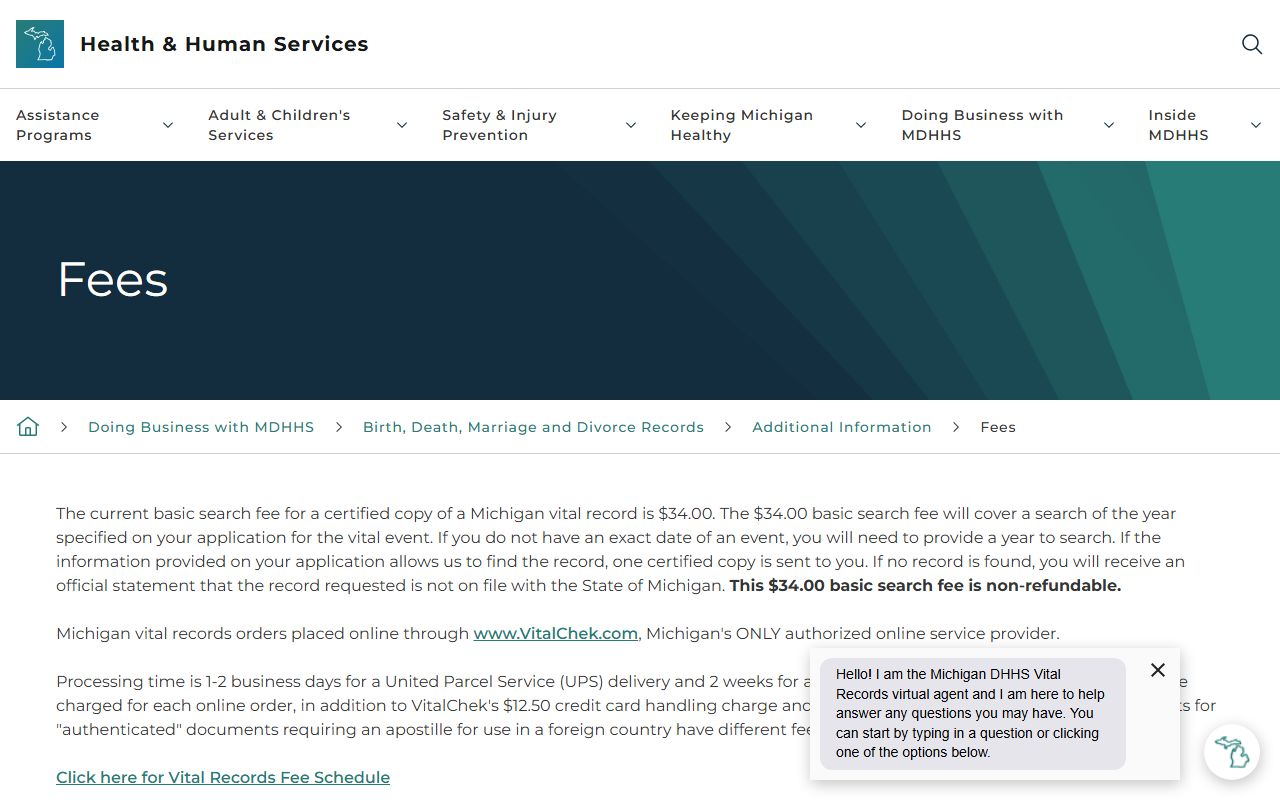
Review the fees page before ordering to understand the total cost, particularly if you plan to use VitalChek or need multiple certified copies of a Michigan death record.
Historical Michigan Death Records and Genealogy
Michigan was an early leader in vital records. Public Act 194 of 1867 required annual recording of all deaths. Before that, local records were scattered. Even after 1867, some deaths in remote areas of the Upper Peninsula went unregistered. Public Act 217 of 1897 required formal death certificates starting in 1898. This is the baseline for detailed modern records in Michigan.
The Library of Michigan at 702 W. Kalamazoo St., Lansing holds microfilm collections for the death record index from 1867 to 1914. It also has original death returns from 1867 to 1897 and microfilmed certificates from 1897 to 1920. The Library's vital records guide at michigan.gov/libraryofmichigan describes these holdings in detail. The Library also provides access to Ancestry Library Edition and FamilySearch during in-library visits.
FamilySearch at familysearch.org has Michigan death record collections covering multiple time periods, including an index that runs through 1971. Most of its Michigan holdings are free to search and view. Ancestry.com also has a Michigan death records collection from 1867 to 1952 for subscribers.
The Library of Michigan vital records guide describes the microfilm and digital holdings available to researchers at the Lansing library location.
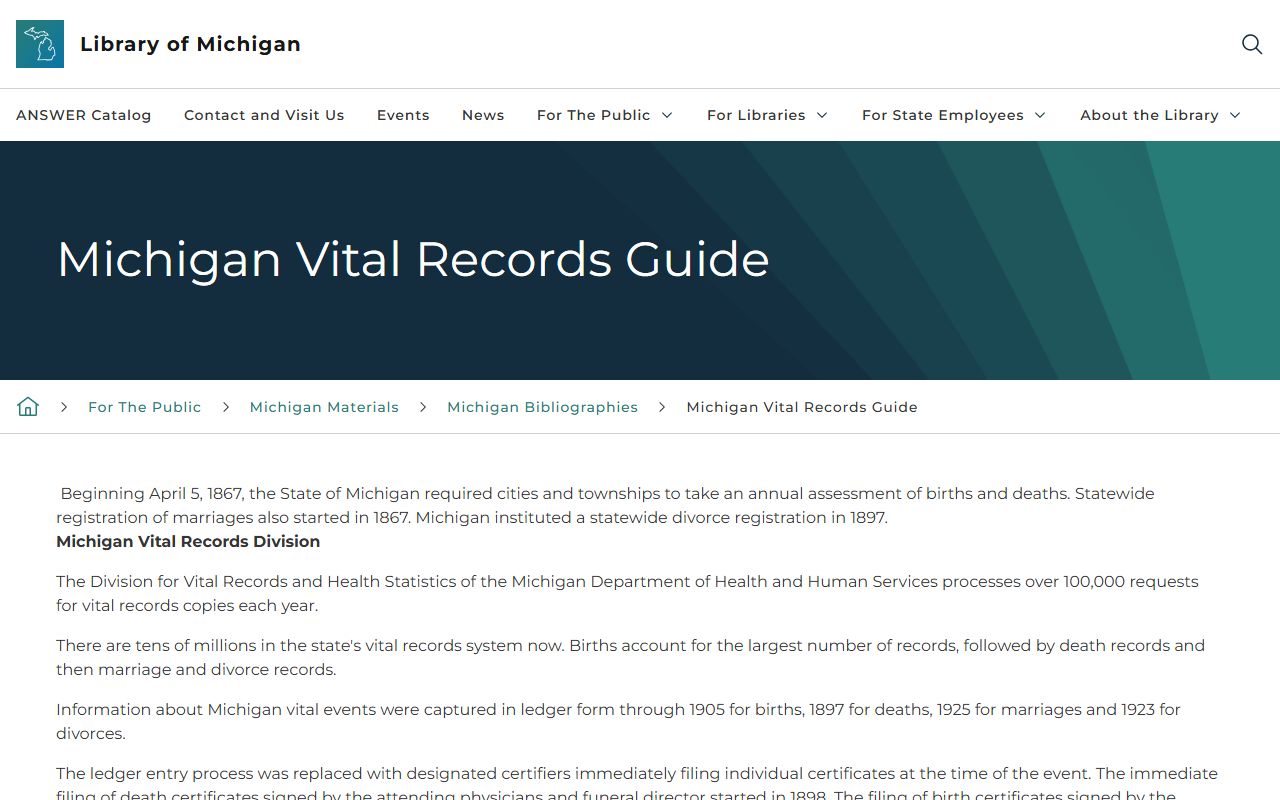
The Library holds the Michigan Death Index from 1867 to 1914, original death returns from 1867 to 1897, and microfilmed death certificates covering 1897 to 1920.
Michigan Electronic Death Registration
Michigan uses an Electronic Death Registration System (EDRS) to file death certificates. The system launched in a 2010 pilot covering Washtenaw and Jackson counties. It now operates in every Michigan county except Ontonagon, which remains the only county still using paper-based filing.
The EDRS at michiganedrs.org lets funeral directors, medical certifiers, and local medical examiners complete and submit death certificates online. It is available 24 hours a day, seven days a week. Authentication uses a fingerprint scanner, which is provided at no cost to registered users. The system reduces errors that happen with handwritten forms and speeds up the processing of certificates. Because death records enter the MDHHS system faster, certified copies are available sooner after a death than in states that still use paper.
The Michigan Electronic Death Registration System at michiganedrs.org connects funeral directors, physicians, and local registrars to file death certificates digitally in 82 of Michigan's 83 counties.
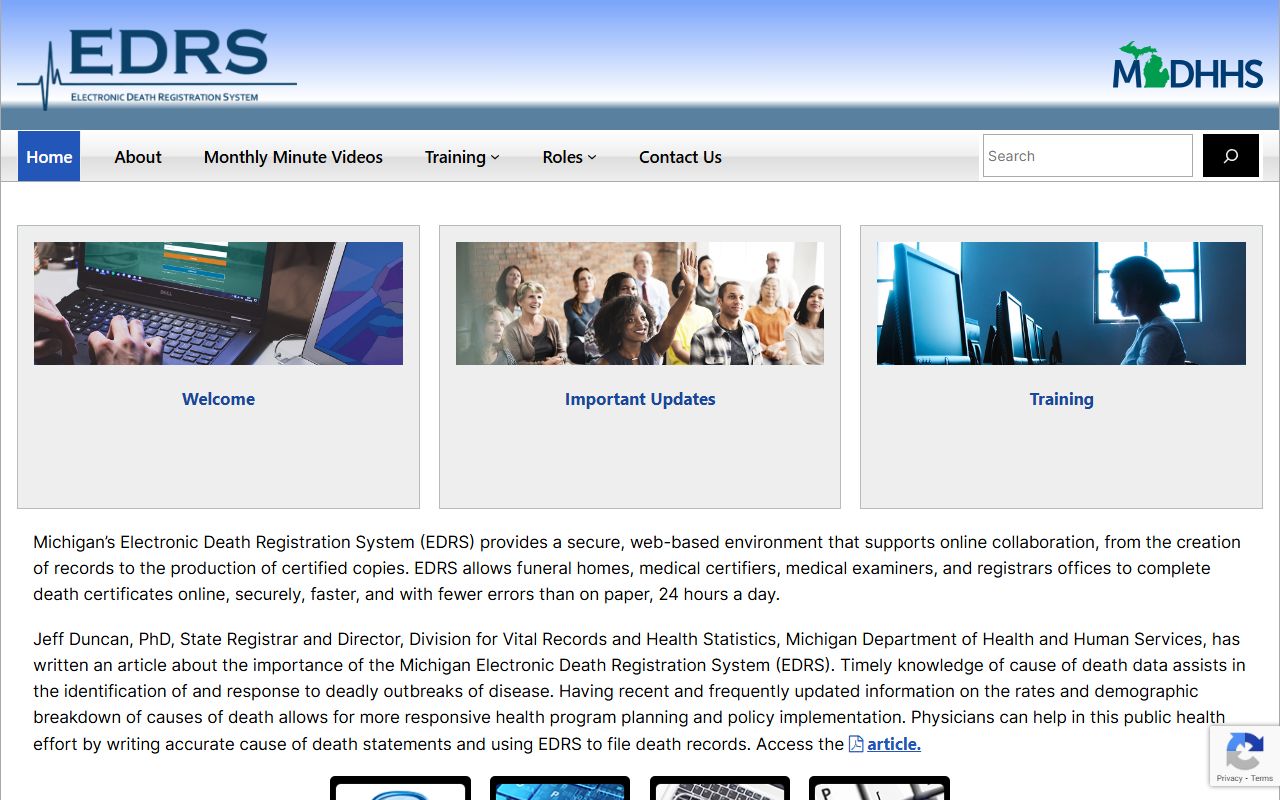
The EDRS reduces filing errors and speeds up the issuance of certified copies, meaning Michigan death records are added to the state's index more quickly after a death occurs.
Note: Ontonagon County is the only Michigan county not using the EDRS; paper-based death certificate filing remains in use there.
Browse Michigan Death Index by County
Michigan has 83 counties. Each county clerk holds death records for deaths that occurred within that county. Select a county below to find local clerk contact information, fees, and resources.
Michigan Death Index by City
Most Michigan cities rely on the county clerk for death records. Some larger cities maintain their own records. Select a city below to find the right office for that area.